
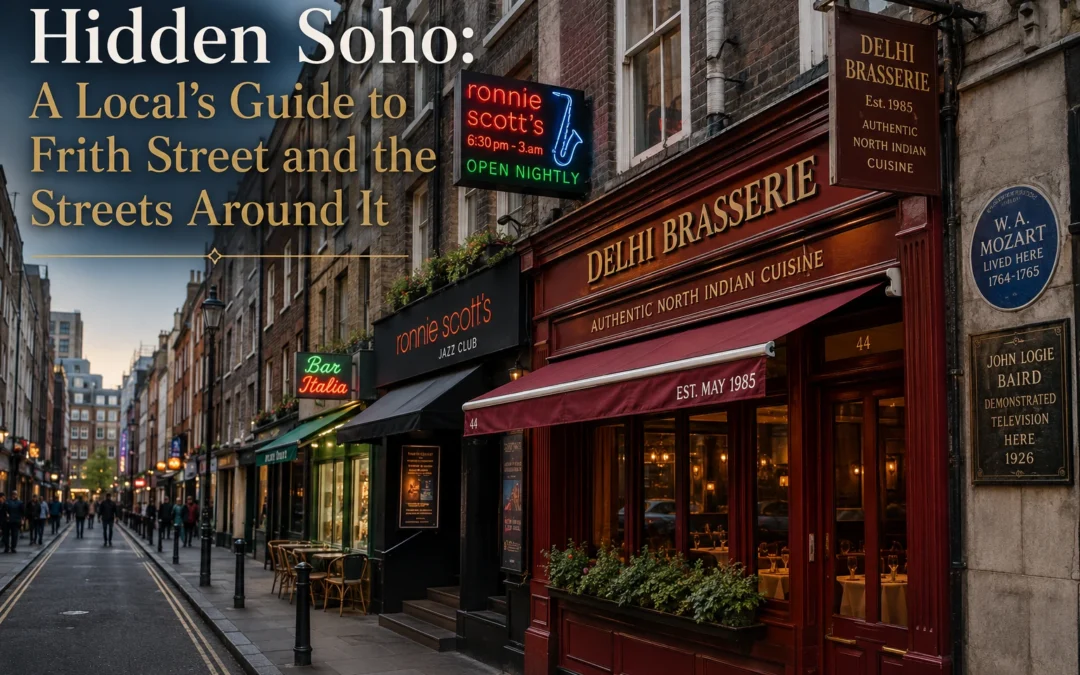
What is there to actually see on Frith Street in Soho? More than most visitors expect. This one short street holds a Mozart plaque, the birthplace of television, and one of London’s most famous jazz clubs, all within a five-minute walk. Add the quiet lanes around it, Greek Street, Dean Street, Old Compton Street, and Bateman Street, and you get one of the richest small pockets of history in Central London.
This guide walks you through Frith Street and the streets that wrap around it, the way a local would show a friend. No rushing between ten landmarks. Just one manageable route, some real history, and a good place to end up for dinner.
Where Is Frith Street in Soho?
This street runs north to south through the heart of Soho, London. It connects Soho Square at the top to Old Compton Street at the bottom, close to Shaftesbury Avenue.
It sits within easy walking distance of:
- Leicester Square
- Piccadilly Circus
- Covent Garden
- Oxford Street
- Trafalgar Square
Because of this, Frith Street works well as a stop before or after the theatre. Most West End shows are a ten to fifteen minute walk away.
A Short History of Frith Street
The street takes its name from Richard Frith, a builder who developed the area in the late 1600s. Early maps of London actually list it as Thrift Street before the name settled into what we call it today.
A few facts make this short stretch of Soho stand out:
- Mozart lived here as a child. A plaque near the Prince Edward Theatre stage door marks the house at No. 20, where a nine-year-old Mozart stayed with his family in 1764 and 1765.
- Television was born here. John Logie Baird gave the world’s first public demonstration of television at No. 22 in January 1926. The site is now home to Bar Italia.
- Ronnie Scott’s Jazz Club sits at No. 46. The club moved here from nearby Gerrard Street in 1965, having first opened its doors in 1959.
Few streets this size can claim a composer, an inventor, and a jazz legend as neighbours. That mix of culture is part of what makes Soho’s back streets worth exploring on foot rather than passing through in a taxi.
What to See Walking Down Frith Street
A slow walk from top to bottom takes about ten minutes if you stop to look around. Along the way, you will pass:
- Bar Italia – an Italian café on the site of Baird’s original television demonstration
- The Mozart plaque – near the Prince Edward Theatre stage door
- Ronnie Scott’s Jazz Club – London’s best-known jazz venue, open since 1959 and based here since 1965
- Independent cafés and restaurants – many family-run for decades, giving the street a lived-in feel rather than a tourist one
It’s a short walk, but it rewards a slower pace. Most of the history hides behind plain doorways with no signage beyond a small blue plaque.
The Hidden Streets Around Frith Street
Frith Street is only one piece of the puzzle. The lanes around it hold just as much history, and most visitors to Soho walk straight past them.
Old Compton Street
Old Compton Street runs across the bottom of Frith Street and is one of Soho’s busiest thoroughfares. It was laid out in the late 1600s and named after Henry Compton, Bishop of London, who encouraged Huguenot refugees to settle in the area. Since the 1970s, it has grown into the centre of London’s LGBTQ+ community, with the Admiral Duncan pub standing as a well-known symbol of the street’s history.
Greek Street
Greek Street runs parallel to Frith Street and takes its name from a Greek church that once stood nearby. It was first laid out around 1680, making it one of the oldest streets in this part of Soho. Karl Marx attended meetings at No. 18 Greek Street in the 1860s, during his years living nearby on Dean Street.
Dean Street
One road over, Dean Street was built in 1681 and quickly attracted wealthy residents. Karl Marx lived at No. 28 from 1851 to 1856, in the cramped upstairs rooms of what is now the Quo Vadis restaurant. The street is also home to The French House, a pub that served as an informal meeting point for Charles de Gaulle’s Free French forces during the Second World War, and to the former Colony Room, a private drinking club favoured by painter Francis Bacon.
Bateman Street
Bateman Street is a short connecting road between Frith Street and Dean Street. It was once called Queen Street and has a reputation as one of Soho’s quieter, older lanes.
Carlisle Street
Carlisle Street sits just north, near Soho Square. It is one of the smaller, quieter streets in the area, useful as a shortcut if you want to avoid the busier main roads during peak hours.
Together, these streets form a small grid where you can walk in a loop and see centuries of London history without ever crossing a main road.
A Soho Walking Route You Can Follow in One Afternoon
If you want a simple route rather than wandering at random, try this:
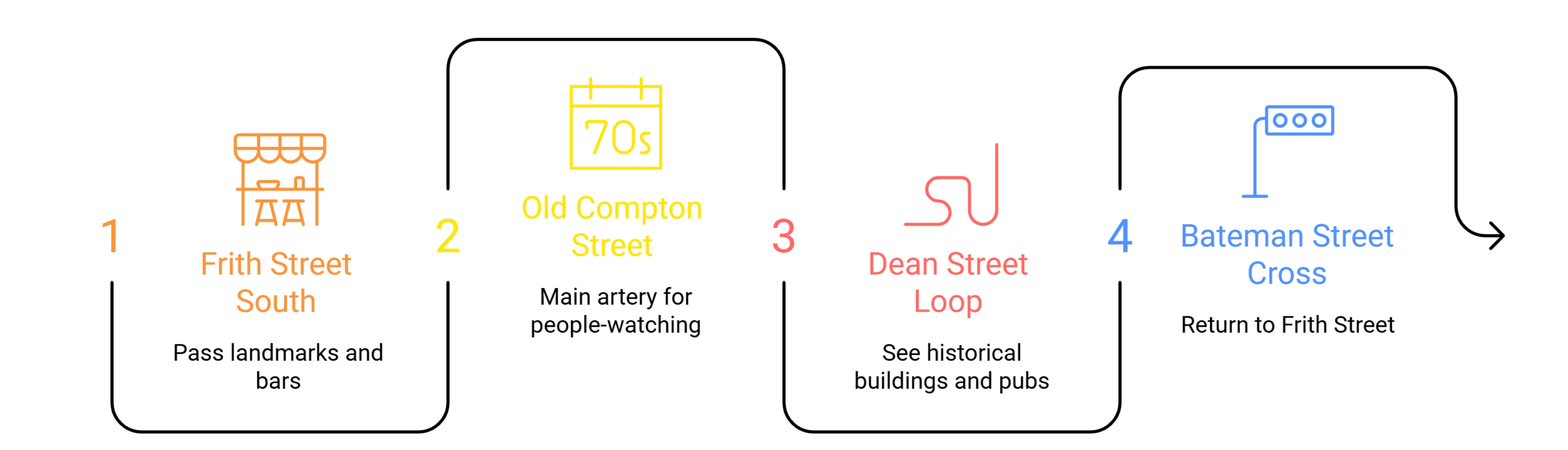
This route takes around 45 minutes at a relaxed pace, longer if you stop for photos or a coffee. It works well before an evening show, since most of it stays within walking distance of Shaftesbury Avenue’s theatres.
Where to Eat After Your Walk: Delhi Brasserie on Frith Street
After a walk through Soho’s back streets, this stretch of Soho is a good place to stop for dinner. The Delhi Brasserie has served authentic North Indian cuisine at 44 Frith Street since May 1985, making it one of Soho’s longest-established Indian restaurants.
A few practical details:
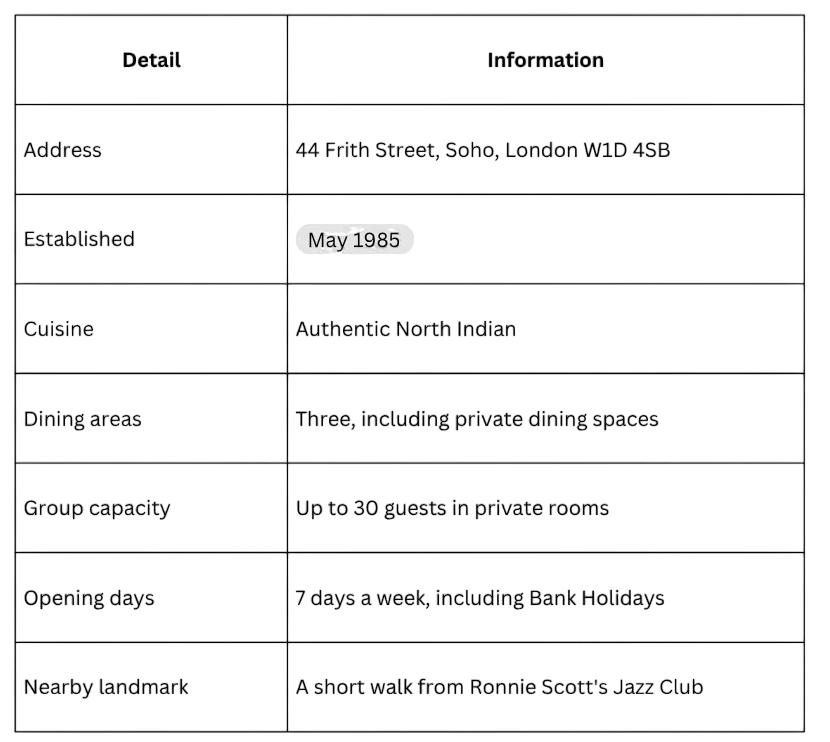
The restaurant is family-run and stands within a few minutes’ walk of Leicester Square, Piccadilly Circus, and most West End theatres, making it a practical choice for pre-theatre or post-theatre dinner. Its three separate dining areas also suit small private parties, business dinners, and celebration bookings such as birthdays and anniversaries.
Practical Tips for Walking Soho’s Hidden Streets
- Best time to visit: Late morning or early evening, before the after-work crowds arrive on Old Compton Street.
- Nearest tube stations: Leicester Square, Tottenham Court Road, and Piccadilly Circus are all within a five to ten minute walk.
- What to bring: Comfortable shoes. The pavements around Soho’s older streets are uneven in places.
- Combine with theatre plans: Most Shaftesbury Avenue theatres are close enough to fit this walk in before a pre-theatre dinner booking.
Frequently Asked Questions
1.What is Frith Street known for? It’s known for its history connected to Mozart, John Logie Baird’s first television demonstration, and Ronnie Scott’s Jazz Club. It also has a long-standing reputation for independent restaurants, including some of Soho’s oldest Indian dining spots.
2.Is Frith Street a good street to visit in Soho? Yes. It combines historical landmarks with restaurants and cafés, and lies close to Soho Square, Old Compton Street, and the West End theatres, making it easy to include in a wider Soho walk.
3.How long does it take to walk around Soho’s hidden streets? A relaxed walk covering Frith Street, Old Compton Street, Dean Street, Greek Street, and Bateman Street takes around 45 minutes without stops, or up to 90 minutes with photo and coffee breaks.
4.What is the nearest tube station to Frith Street? Leicester Square station is the closest, about a five-minute walk away. Tottenham Court Road and Piccadilly Circus stations are also within easy reach.
5.Where can I eat on Frith Street? There’s a mix of cafés and restaurants, including Bar Italia and the Delhi Brasserie, a North Indian restaurant that has operated at No. 44 since May 1985.
6.Are Frith Street and Ronnie Scott’s Jazz Club close together? Yes. Ronnie Scott’s is located at No. 46, right in the middle of the street, close to several long-standing restaurants nearby.
7.What hidden streets should I explore near Frith Street? Greek Street, Dean Street, Bateman Street, and Carlisle Street all connect to it and hold their own history, from Karl Marx’s former home on Dean Street to the wartime history of The French House, also on Dean Street.
8.Is Soho safe to walk around during the day and evening? Soho’s main streets, including Frith Street and Old Compton Street, are busy and well-lit through the day and into the evening. As with any central London area, it is sensible to stay alert in crowded spots and keep valuables secure.
Frith Street proves that some of London’s best history is not found in its famous landmarks, but tucked into short streets most people walk past without a second look. Whether you are visiting for a pre-theatre dinner, a weekend walk, or a quiet evening meal, this small stretch of Soho, and a table at the Delhi Brasserie, is worth the detour.


