
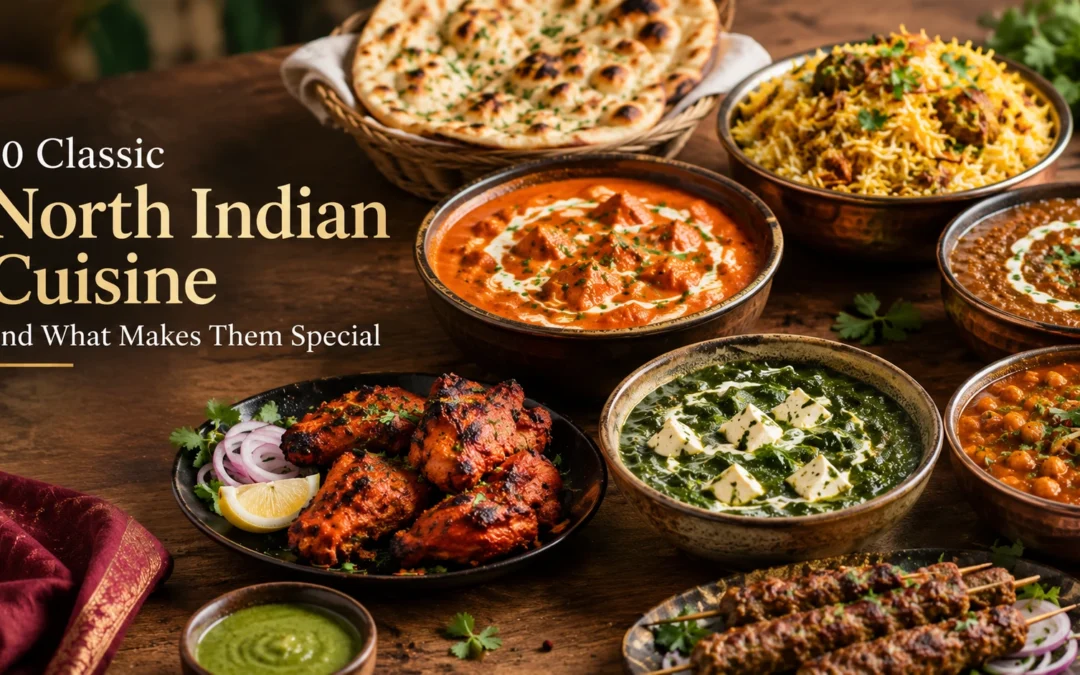
When you think of North Indian food, a few classics probably come to mind: butter chicken, tandoori chicken, rogan josh, dal makhani, chole, palak paneer, lamb pasanda, seekh kebab, biryani and naan.
What makes these dishes so distinctive comes down to two things: cooking in a clay oven at incredibly high temperatures, and building rich, flavourful gravies slowly with whole Indian spices rather than taking shortcuts.
That combination is really at the heart of North Indian cooking. It’s also what we’ve been serving at Delhi Brasserie on Frith Street in Soho, where we’ve been introducing London diners to these traditional flavours for around forty years.
So, if you’re wondering what makes each dish special – and which one might be right for you – here’s a simple guide to ten classic Indian dishes, what goes into them, and the kind of diner who might enjoy them most.
Quick Answer: The 10 Classic North Indian Dishes

What Counts as North Indian Cuisine?
North Indian cooking comes from Punjab, Delhi, Uttar Pradesh, Rajasthan and Kashmir. The region is wheat country rather than rice country, so bread sits at the centre of the meal.
Three habits define the style:
- Clay oven cooking. A tandoor burns at roughly 400–480°C. Meat seals fast and stays juicy.
- Dairy. Yoghurt, cream, ghee and paneer soften heat and carry flavour.
- Whole spices bloomed in fat. Cumin, cardamom, cloves and bay go into hot oil first. This step builds the base of most indian curry dishes.
South Indian cooking leans on rice, coconut, curry leaves and fermented batters. Same country, different kitchen. Both are authentic indian food; they simply come from different regions with different pantries.
Indian food is no small part of British life. More than 10,000 Indian restaurants trade across the UK and contribute around £4 billion a year to the economy, according to the British Indian Good Food Guide (2024). The wider Asian restaurant sector employed roughly 164,500 people in the UK in 2025 (IBISWorld, 2025).
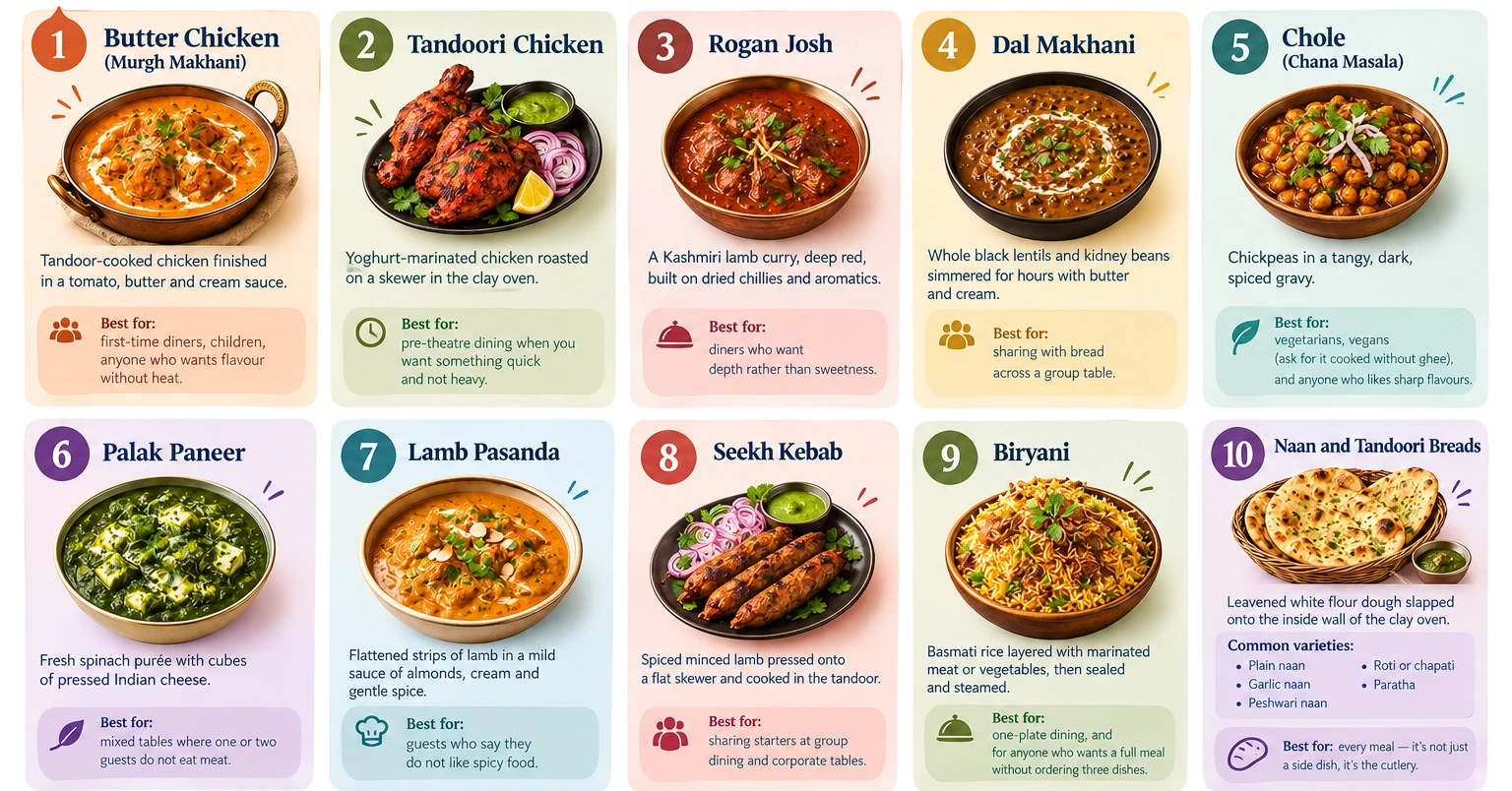
1. Butter Chicken (Murgh Makhani)
What it is: Tandoor-cooked chicken finished in a tomato, butter and cream sauce.
Butter chicken was created in Delhi in the late 1940s at Moti Mahal, where cooks stirred leftover tandoori chicken into a tomato and butter gravy so it would not dry out. The dish travelled from there to menus worldwide.
Authentic indian butter chicken has a few markers:
- The chicken is grilled in the tandoor before it meets the sauce
- The gravy tastes of tomato and fenugreek leaf, not sugar
- The colour is soft orange, never bright red
Order this dish first if you want proof a kitchen is serious about authentic indian butter chicken rather than a bottled sauce version.
Best for: first-time diners, children, anyone who wants flavour without heat.
2. Tandoori Chicken
What it is: Yoghurt-marinated chicken roasted on a skewer in the clay oven.
The marinade does the work. Yoghurt and lemon juice tenderise the meat, while ginger, garlic, chilli and garam masala sit on the surface. Fifteen minutes over live charcoal gives the smoke.
Tandoori chicken is also one of the lighter indian restaurant dishes, since nothing is fried and no cream is added.
Best for: pre-theatre dining when you want something quick and not heavy.
3. Rogan Josh
What it is: A Kashmiri lamb curry, deep red, built on dried chillies and aromatics.
Rogan josh gets its colour from Kashmiri chillies, which give red without fierce heat. Some versions use ratan jot, a natural root colouring. The lamb cooks slowly until the sauce clings to it.
Real rogan josh contains no tomato and no cream in its Kashmiri form. Punjabi kitchens often add both. Both versions are honest, and they taste different.
Best for: diners who want depth rather than sweetness.
4. Dal Makhani
What it is: Whole black lentils and kidney beans simmered for hours with butter and cream.
This is Punjab’s most patient dish. The lentils soak overnight, then cook low and slow until they collapse into something thick and glossy. Rushed dal makhani tastes thin. There is no way to hide it.
It also shows how good indian vegetarian dishes can be without pretending to be meat.
Best for: sharing with bread across a group table.
5. Chole (Chana Masala)
What it is: Chickpeas in a tangy, dark, spiced gravy.
Chole is Delhi street food that earned a place at dinner. The sourness comes from amchur (dried mango powder) or pomegranate seed powder, not vinegar. Tea leaves are sometimes added to the cooking water to darken the chickpeas.
Chickpeas carry protein and fibre, which makes this one of the more filling meat-free options on the menu.
Best for: vegetarians, vegans (ask for it cooked without ghee), and anyone who likes sharp flavours.
6. Palak Paneer
What it is: Fresh spinach purée with cubes of pressed Indian cheese.
Paneer does not melt, so it holds its shape in a hot sauce. The spinach is blanched quickly to keep it green, then blended with ginger, garlic and green chilli.
A good palak paneer tastes of spinach first and spice second. If it tastes only of cream, something went wrong.
Best for: mixed tables where one or two guests do not eat meat.
7. Lamb Pasanda
What it is: Flattened strips of lamb in a mild sauce of almonds, cream and gentle spice.
Pasanda comes from Mughal court cooking. The word relates to pasande, meaning favourite cut. Meat was beaten thin, marinated in yoghurt, then cooked in a nut-based sauce.
It is one of the mildest north indian dishes on any menu, and one of the richest. Lamb Pasanda appears on our own chef’s set menu at Delhi Brasserie for exactly that reason.
Best for: guests who say they do not like spicy food.
8. Seekh Kebab
What it is: Spiced minced lamb pressed onto a flat skewer and cooked in the tandoor.
The mince is worked with onion, green chilli, coriander and garam masala until it turns sticky. That texture is what keeps it on the skewer. Charcoal heat does the rest.
Seekh kebabs arrive as a starter, usually with sliced onion and mint chutney. They set up the meal without filling you, which is why they sit near the top of most indian restaurant dishes ordered as starters.
Best for: sharing starters at group dining and corporate tables.
9. Biryani
What it is: Basmati rice layered with marinated meat or vegetables, then sealed and steamed.
The method matters more than the recipe. Rice is parboiled, layered over the meat with saffron milk and fried onions, then the pot is sealed so steam cooks everything together. This is called dum cooking.
A biryani should come apart in separate grains. Each one should taste of the meat below it.
Best for: one-plate dining, and for anyone who wants a full meal without ordering three dishes.
10. Naan and Tandoori Breads
What it is: Leavened white flour dough slapped onto the inside wall of the clay oven.
Naan needs a tandoor. The dough sticks to the hot clay, puffs in under two minutes, and comes off blistered on one side and soft on the other. A home oven cannot copy it. Some naan varieties carry indian spices baked right into the dough, such as ajwain or nigella seed.
Common varieties:
- Plain naan – the default partner for indian curry dishes
- Garlic naan – topped with garlic and coriander
- Peshwari naan – sweet, filled with almond and coconut
- Roti or chapati – wholemeal, no yeast, lighter
- Paratha – layered and flaky
Bread is not a side dish in north indian cooking. It is the cutlery.
What Makes These Dishes Taste Authentic
Four things separate authentic indian food from an average curry:
- Whole spices, ground in house. Pre-ground powder loses its oils within weeks.
- Onion and tomato cooked properly. The base needs 20–30 minutes before anything else goes in. Rushing it leaves a raw edge.
- A working tandoor. No grill reproduces clay oven cooking.
- Separate gravies. One shared sauce dyed different colours is the clearest sign of a shortcut kitchen.
Indian flavours are layered rather than hot. Heat is one note among many, not the whole dish. A kitchen that understands this builds indian flavours in stages, from the fat the spices bloom in to the garnish added at the very end.
Where to Eat Traditional North Indian Cuisine in Soho, London
Delhi Brasserie sits at 44 Frith Street, W1D 4SB, in the middle of Soho. We have been serving north indian cuisine here for around four decades, and the kitchen is run by Indian chefs cooking from original recipes.
Getting here:
- Leicester Square and Tottenham Court Road stations: under 5 minutes on foot
- Piccadilly Circus and Oxford Street: around 8 minutes
- Covent Garden and Trafalgar Square: 10–12 minutes
- Most West End theatres: within a 10 minute walk
What we host:
- Pre-theatre and post-theatre dining
- Private dining in three separate rooms, for parties up to 30
- Group bookings and corporate lunches or dinners
- Birthdays, anniversaries and celebration menus
- Takeaway for collection, and delivery through Deliveroo
We open at 17:00 seven days a week, 365 days a year, including bank holidays. Kitchen closes at 23:30 Sunday to Thursday, and midnight on Friday and Saturday.
To book, call 020 7437 8261 after 4pm, WhatsApp 07562 600591 at any time, or reserve online at delhibrasserie.com.
Ready to Try the Real Thing?
Reading about north indian cuisine only goes so far. The smoke off a tandoori skewer, the first tear of hot naan, a dal that has been on the stove since morning: these are things you have to sit down for.
Delhi Brasserie has been doing this on Frith Street for forty years, for Soho locals, theatre-goers, families and visitors passing through Central London.
Book your table: call 020 7437 8261, WhatsApp 07562 600591, or reserve online at delhibrasserie.com.
The Delhi Brasserie, 44 Frith Street, Soho, London W1D 4SB. Open 7 days a week from 17:00.
Frequently Asked Questions
1. What is the most popular North Indian dish in the UK?
Butter chicken and chicken tikka masala are the two most ordered. Chicken tikka masala was called Britain’s national dish by then Foreign Secretary Robin Cook in a 2001 speech, and the phrase stuck.
2. Is North Indian food very spicy?
Not usually. Most traditional indian dishes from the north are built on aromatic spices such as cumin, cardamom and coriander rather than chilli. Korma, pasanda, butter chicken and dal makhani are all mild. You can also ask for any dish to be adjusted.
3. What is the rr vedifference between North Indian and South Indian food?
North Indian cooking uses wheat breads, dairy, dried spices and the tandoor. South Indian cooking uses rice, coconut, curry leaves, mustard seed and fermented batters for dishes such as dosa and idli.
4. Are there good vegetarian options in North Indian cuisine?
Yes. Dal makhani, palak paneer, chole, baingan bharta, aloo gobi and paneer tikka are all core dishes, not afterthoughts. Many indian vegetarian dishes predate the meat recipes on the same menu.
5. Can I eat North Indian food before a West End show?
Yes. Order tandoori starters and a single main with rice or bread, and a table of two can finish comfortably inside an hour. Tell your server your curtain time when you sit down and we will pace the kitchen accordingly.
6. What should I order on a first visit to an Indian restaurant?
A simple three-part order works well: one tandoori starter such as seekh kebab, one mild gravy dish such as butter chicken or lamb pasanda, and one vegetable dish such as dal makhani. Add naan and pilau rice to share.
7. What is a tandoor and why does it matter?
A tandoor is a cylindrical clay oven heated by charcoal to around 400–480°C. That heat seals meat in minutes and bakes naan in under two. Clay oven cooking gives the smoke and char you cannot get from a domestic oven.
8. Do you take large group and private dining bookings in Soho?
Yes. Delhi Brasserie has three separate dining areas suitable for private parties of up to 30 guests. Online booking covers parties up to 20. For Friday and Saturday bookings over 8 people, please call the restaurant directly.


